Holiday making
Yarn for Christmas Stockings: Size, Colour and Quantity
A decorative Christmas stocking has different demands from a sock worn inside a shoe. Decide its finished size, how it will hang and how you want to use colour before choosing the yarn.
Some links in this guide are affiliate links. We earn a commission on purchases made through them, at no extra cost to you.
Find a stocking pattern, not just a sock pattern
A full-size hanging stocking is not automatically a wearable sock enlarged on bigger needles. Its opening, heel, toe and hanging loop must work together at the intended scale. Choose a pattern written as a decoration, or follow a designer’s explicit adaptation instructions. This article is a yarn-planning guide, not a graded stocking pattern.
Record the finished height and width, the required tension and the amount of each colour. If you are making stockings for several people, choose the largest name panel before you start the first cuff. A longer name can change the spacing that makes the set look coordinated.
| Yarn characteristic | Useful question | Trade-off to consider |
|---|---|---|
| Smooth wool | Do you want crisp stranded motifs? | Check washing instructions and the hanging fabric |
| Superwash wool | Will the recipient want easier washing? | Wash the sample before measuring; the fabric may change |
| Cotton or plant-fibre blend | Do you want a firm, defined fabric? | Check the weight of the stocking and its stretch when hung |
| Brushed or fluffy yarn | Is a soft outline part of the design? | Small letters and detailed motifs may be harder to read |
Plan colourwork around the motif
Two yarns labelled worsted or aran can still differ in thickness and bloom. For a colourwork stocking, compare both colours in the same swatch and wash them together before making the full piece. Choose contrast that remains readable when you look at the fabric from across the room, not just under a bright desk lamp.
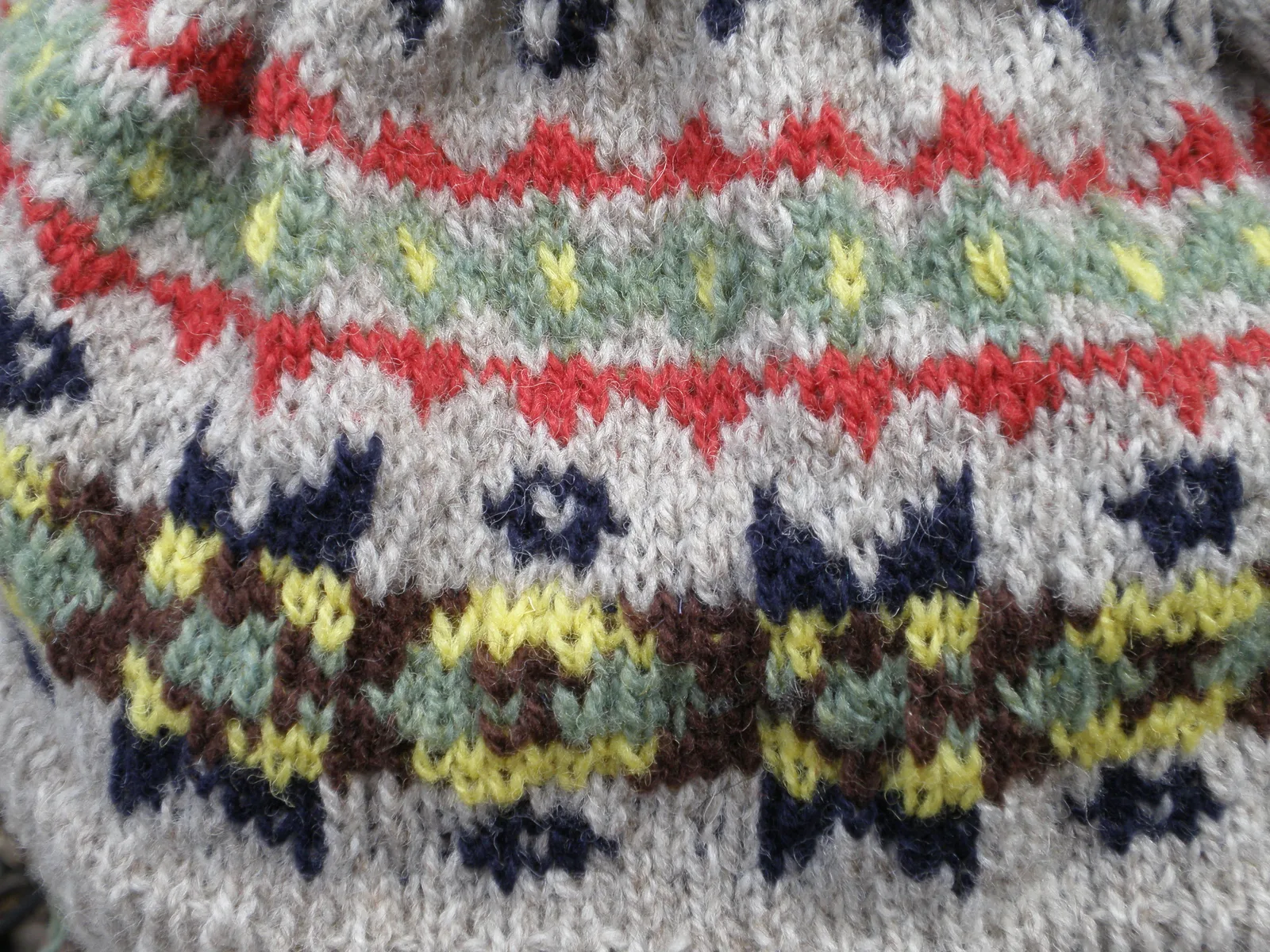
Keep a colour allocation for the cuff, name panel, main fabric, heel and toe. The accent colour may be used only briefly, but running out halfway through a name is still running out. Buy from the pattern’s per-colour requirements rather than dividing the total length equally.
Calculate quantity from the stated length
If a pattern needs 350 metres of its main colour and the replacement has 192 metres per ball, two balls supply 384 metres. That covers the stated requirement, not every possible change. A longer leg, folded cuff, bigger size or added motif needs its own allowance. Use the pattern notes to decide whether an allowance is already included.
- Write the full yarn name, colour and dye lot for every stocking in a set.
- Keep a small amount of each colour for future repairs or a matching stocking.
- Test the stocking with a light display load; a hanging loop is not a promise of unlimited carrying strength.
- If you add a lining, treat it as a separate sewing and fit task rather than assuming it fixes every stretchy fabric.
Make the second stocking easier
Write down the needle or hook diameter in millimetres, your washed measurements and the number of repeats you used. A photo beside a ruler helps you repeat the scale next year. Keep the finished stocking pattern with those notes so a new family stocking can match the originals.
Questions
Can I use sock yarn for a Christmas stocking?
Use it if the chosen stocking pattern is written for that thickness, or if you are deliberately following a tested adaptation. Sock yarn on a much larger needle does not automatically produce a sturdy decorative fabric.
Are worsted and aran interchangeable?
They overlap in some product ranges, but the names do not establish a match. Compare the yarn specifications and your washed tension square.