Tools & techniques
Knitting Needle Types: Straight, Circular, DPNs and More
Knitting needles come in four main shapes and half a dozen materials, and the right one depends on what you're knitting, not on what's traditional. Here's what each type is for, which cable length fits which project, how materials change the feel, and how to read a needle size.
Some links in this guide are affiliate links. We earn a commission on purchases made through them, at no extra cost to you.
The main types at a glance
| Type | Knits | Best for |
|---|---|---|
| Straight | Flat only | Scarves, dishcloths, flat pieces for seaming |
| Fixed circular | Flat or in the round | Hats, sweaters, shawls, blankets |
| Interchangeable circular | Flat or in the round | Everything, once you knit a lot |
| Double-pointed (DPNs) | Small rounds | Socks, mittens, sleeves, hat crowns |
| Flexible DPNs | Small rounds | Socks and sleeves with fewer needles to manage |
| Cable needle | A few held stitches | Crossing stitches in cables |
Straight needles
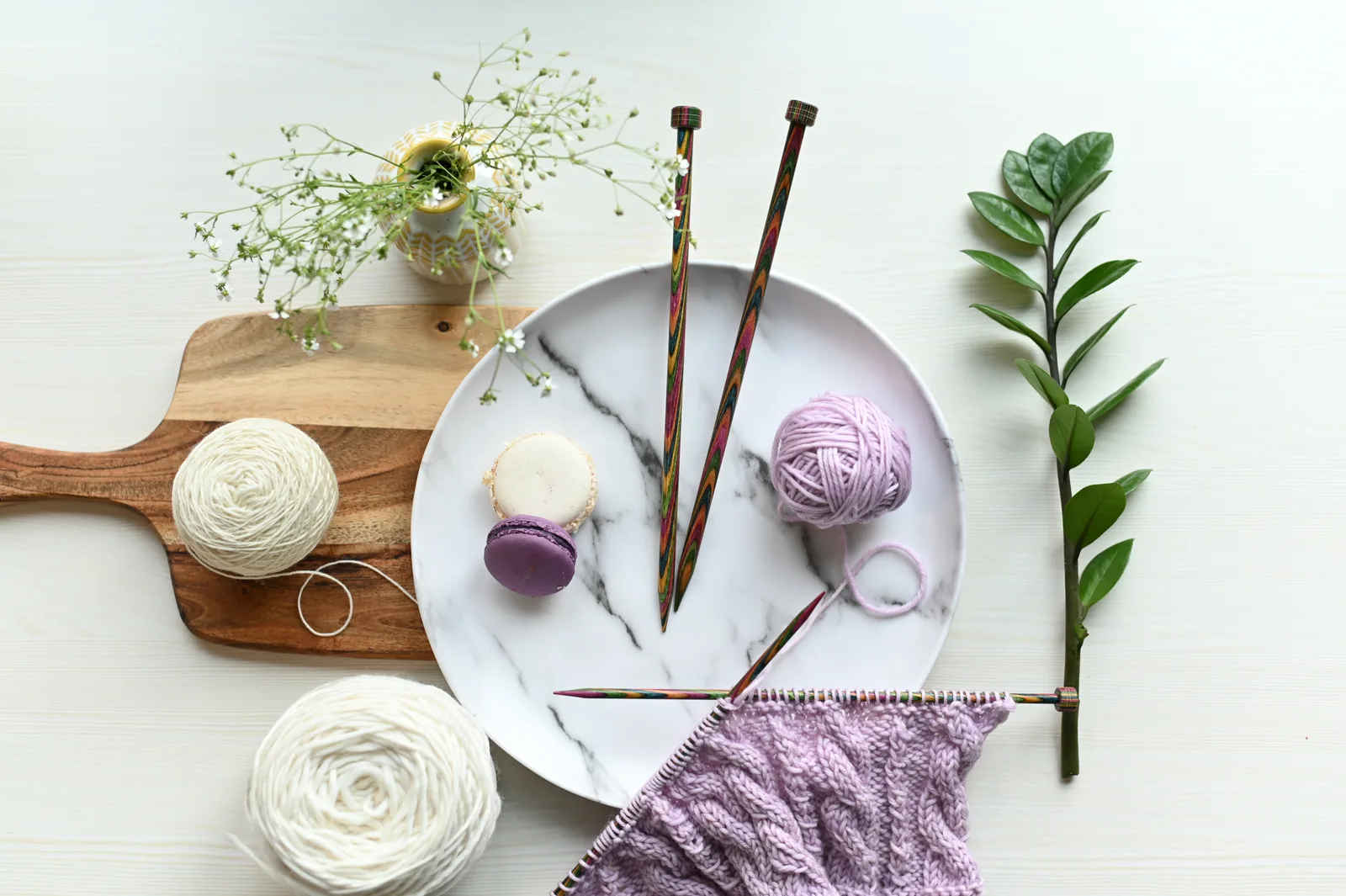
Straight needles have a point at one end and a knob at the other, and are sold in pairs, usually 10 in (25 cm) or 14 in (35 cm) long. They're simple and easy to learn on, but they only knit flat, and the whole weight of the project sits on two long levers. A blanket or a sweater back on 14 in straights gets heavy and crowded quickly, which is why many knitters switch to circulars even for flat pieces.
Circular needles
A circular needle is two short tips joined by a flexible cable. Join the stitches in a ring and you knit in the round for seamless hats, cowls and sweaters; turn at the end of each row and you knit flat, with the weight of the fabric resting in your lap on the cable instead of on your wrists.
Circular needles are measured from tip to tip, and the length matters for knitting in the round: the needle has to be shorter than the circumference of what you're knitting, or the stitches won't stretch around it.
| Length (tip to tip) | Use it for |
|---|---|
| 9–12 in (23–30 cm) | Socks and sleeves in the round |
| 16 in (40 cm) | Hats, cowls, baby sweaters, sleeve tops |
| 24 in (60 cm) | Children's sweater bodies, yokes, larger cowls |
| 32 in (80 cm) | Adult sweater bodies, shawls, magic loop |
| 40 in (100 cm) and up | Blankets, big shawls, magic loop for anything small |
Interchangeable sets
An interchangeable set gives you pairs of tips in each size and cables in several lengths. Screw or click the tips you need onto the cable you need, and one case covers almost any project. A good set costs more upfront than a few fixed circulars, but less than a full drawer of them. Before buying, check the joins: they should sit flush so stitches slide over without catching, and screw-on joins should come with a key to tighten them so they don't loosen as you knit.
Double-pointed and flexible needles
Double-pointed needles have a point at both ends and come in sets of four or five, usually 6–8 in (15–20 cm) long. The stitches are spread over three or four needles and you knit around with the spare one. They're the traditional tool for socks, mittens and hat crowns, where the circumference is too small for a circular. They take a few rounds to get used to, and a lost DPN leaves the set one short, so keep them in a case.
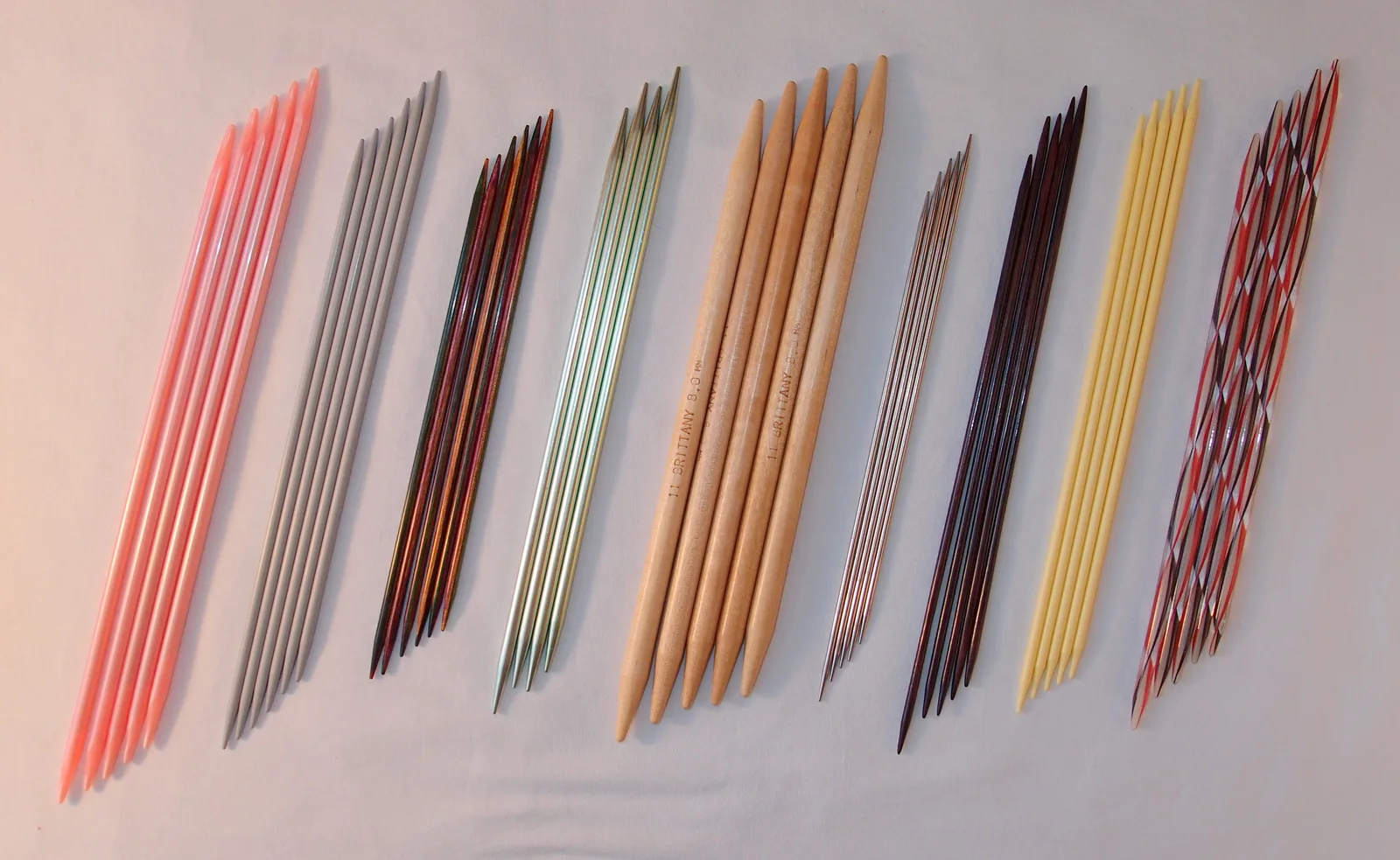
Flexible DPNs are short tips joined by a short flexible cable, sold in sets of two or three. They knit the same small circumferences as DPNs with fewer needle tips to manage, and nothing to drop out of the work. Cable needles are short holders, often U- or J-shaped, that park a few stitches at the front or back while you knit the next ones, crossing them into a cable.
Needle materials
| Material | Speed | Good for | Watch out for |
|---|---|---|---|
| Nickel-plated or stainless steel | Fastest | Grippy wool, fast knitting, lace with sharp tips | Slippery yarns slide off |
| Aluminum | Fast | Everyday knitting on a budget | Can feel cold and noisy |
| Wood and bamboo | Medium | Slippery yarns, beginners, DPNs | Thin sizes can bend or snap |
| Carbon fiber | Medium | Warm feel with strength in fine sizes | Usually paired with metal tips |
| Plastic or resin | Slow to medium | Very large sizes, light weight | Can drag on wool |
Square needles, like addi's Rocket Squared, have a squared-off shaft. Many knitters with sore hands find them easier to grip, and some find their tension evens out. Carbon-fiber needles such as KnitPro Karbonz pair a warm, strong shaft with brass tips, a useful middle ground between wood and metal.
Knitting needle size chart
Needles are sized by diameter in millimeters, and the US numbers are a separate scale. Brands don't always agree between whole sizes: some sell a 3 mm needle as US 2.5, a size the standard chart doesn't list. When a pattern gives both, follow the millimeters. An addi needle gauge sizes any unlabeled needles in the drawer.
| Metric | US | Typical yarn |
|---|---|---|
| 2.0 mm | 0 | Lace, fingering socks |
| 2.25 mm | 1 | Fingering |
| 2.75 mm | 2 | Fingering |
| 3.25 mm | 3 | Fingering to sport |
| 3.5 mm | 4 | Sport |
| 3.75 mm | 5 | Sport to DK |
| 4.0 mm | 6 | DK |
| 4.5 mm | 7 | DK to worsted |
| 5.0 mm | 8 | Worsted |
| 5.5 mm | 9 | Worsted to aran |
| 6.0 mm | 10 | Aran |
| 6.5 mm | 10½ | Bulky |
| 8.0 mm | 11 | Bulky |
| 9.0 mm | 13 | Super bulky |
| 10.0 mm | 15 | Super bulky |
What to buy first
- One 24 in (60 cm) circular in US 8 (5 mm) for learning with worsted yarn. It knits flat now and in the round later.
- A 16 in (40 cm) circular in the same size when you knit your first hat.
- A set of DPNs or a 32 in (80 cm) circular for magic loop when you reach hat crowns and socks.
- An interchangeable set once you're buying a new fixed circular for every project.
See every needle set in the shop.
Questions
Can I knit flat on circular needles?
Yes. Cast on and turn at the end of every row, just as with straights. The cable carries the weight of the fabric, which is easier on the wrists for big pieces.
What's the difference between fixed and interchangeable circulars?
A fixed circular has the tips permanently attached to one cable. Interchangeable tips screw or click onto separate cables, so one set makes many sizes and lengths.
Do needle materials change my gauge?
They can. Yarn slides faster on metal than on wood, so some knitters work a little looser on metal. Swatch on the needles you'll use for the project.